
Your Kid's Loot Boxes Are Training Them for Sports Betting. The 2025 Data Just Confirmed It.
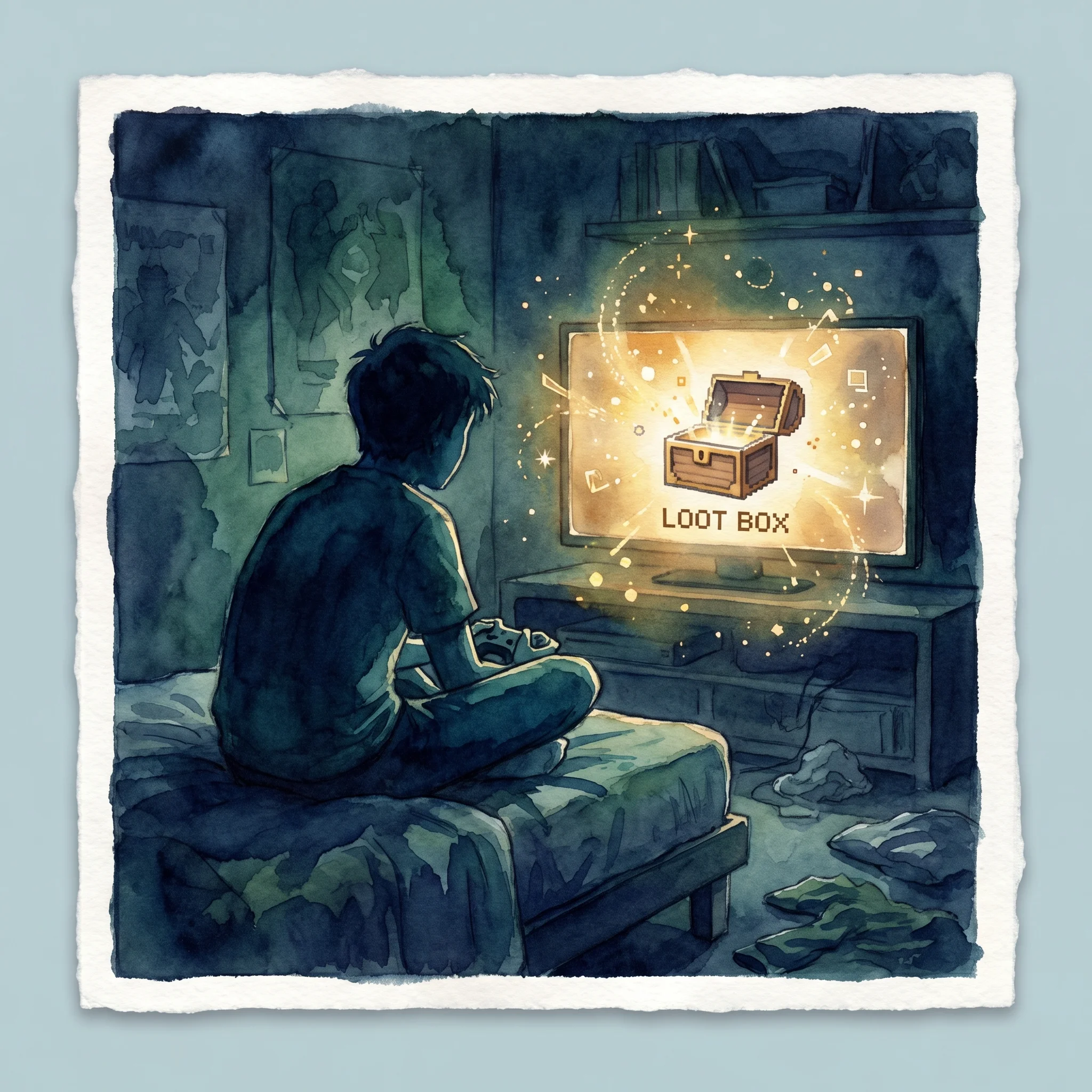
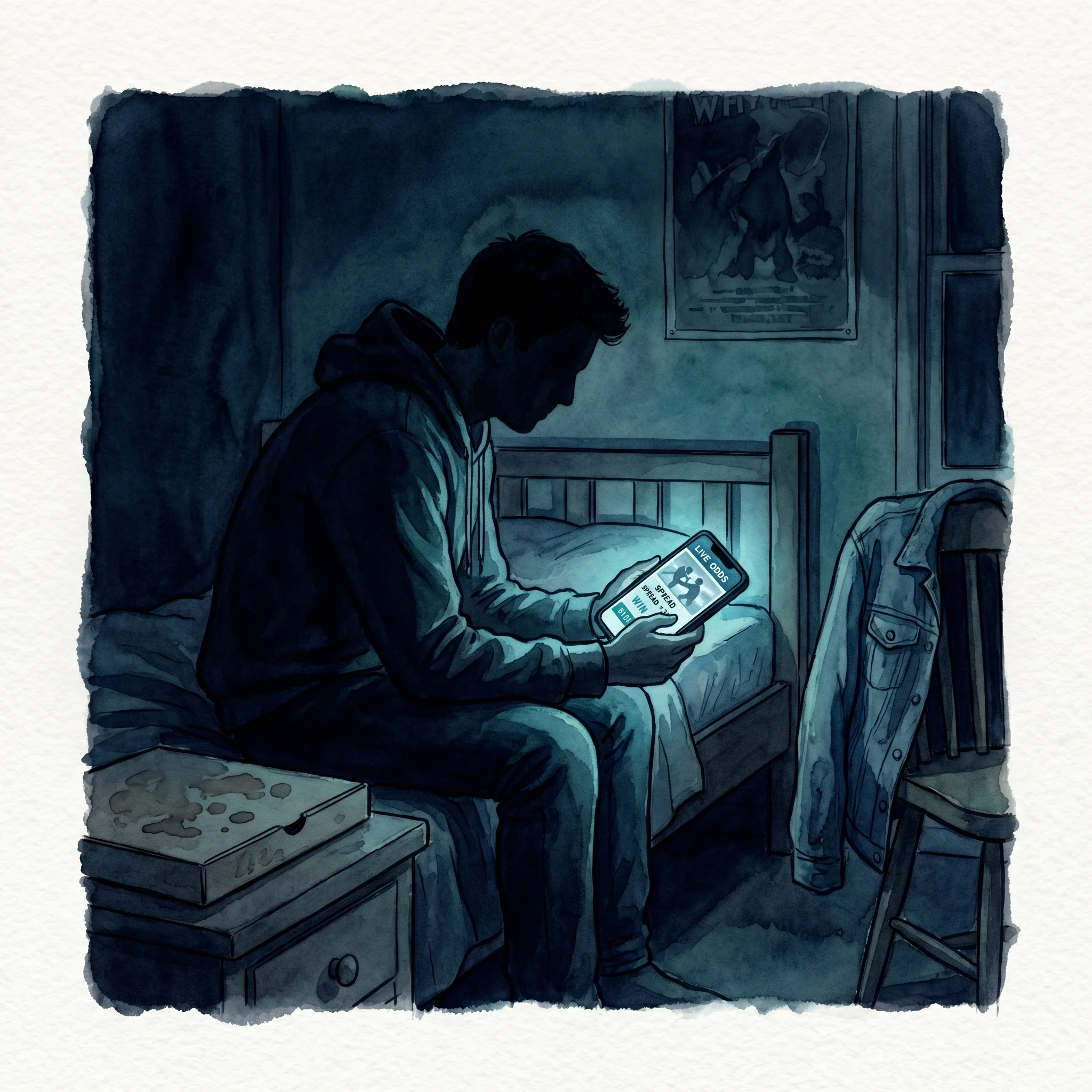
A fourteen-year-old sits on the edge of his bed at night, face lit by a screen. He has been playing for three hours. The last loot box he opened had a 2 percent chance of dropping a rare skin. It did not drop. He spent another $20. His parents are downstairs. They think he is doing homework. They are not worried. They should not be worried about this evening specifically. They should be worried about the evening six years from now when the same boy is sitting on the same bed edge, face lit by a different screen, checking a same-game parlay on his phone twenty minutes after the one before it just lost.
That is not a projection. That is what 2025 research showed happens.
The MechanismWhat A Loot Box Actually Is
A loot box is a paid, randomized reward in a video game. You pay real money (or a premium in-game currency you bought with real money). You do not know what you are going to get. It might be a common item worth a fraction of what you paid. It might be a rare one that feels like a win. The odds are set by the game publisher and disclosed only inconsistently.
The psychological mechanism is called variable ratio reinforcement. It is the exact same schedule slot machines use. Your brain cannot distinguish between the two. When you win, dopamine fires. When you lose, it fires a little too, because the next one might be the one. The near-misses ("so close to the rare skin") are engineered on purpose, because they drive the next purchase more reliably than wins do.
This is not contested science. Researchers have been warning about loot boxes since at least 2018. What changed in 2025 is that the research moved from "we think this is happening" to "we have confirmed it is happening, with longitudinal data, in a second independent cohort."
For a platform where these same mechanics now sit next to outright wagering, see Is Roblox Gambling? The Robux Casino Risk for Kids.
The DataWhat The 2025 Data Showed
A research team led by Drummond and colleagues in British Columbia published a replication study in April 2025 (open-access paper in PMC). They followed young adults over time and confirmed the direction of the effect: loot box spending predicted real-money gambling, not the other way around.
That matters because critics had argued for years that it could be the reverse. Maybe young people who are already drawn to gambling are drawn to loot boxes too, they said. Maybe loot boxes are a symptom, not a cause. The 2025 replication, following a separate cohort with tighter longitudinal controls, showed that the kids who spent more on loot boxes at an earlier age were significantly more likely to develop real-money gambling behavior later, even after controlling for baseline impulsivity and gaming exposure.
In plain language: loot boxes are not just correlated with gambling addiction. They are teaching the same brain circuitry the same lesson, on the same reinforcement schedule, for years, before the kid is legally old enough to walk into a casino.
A separate instrument developed for children ages ten to fourteen, the yRAFFLE scale, came out of 2025 work to measure why kids engage with these mechanics in the first place. It found the dominant motivations were not pleasure or achievement. They were anticipation and chasing losses. Those are also the top two motivations in adult gambling disorder.
The IncentiveWhy The Industry Knows And Ships Anyway
In 2018, the Belgian Gaming Commission ruled paid loot boxes to be gambling under Belgian law and banned them. Publishers complied by pulling loot-box features from Belgian versions of their games. The Netherlands followed with regulation. Japan regulates specific mechanics. The UK Parliament has held multiple inquiries, and NHS England has issued public warnings tying loot boxes to early-onset problem gambling risk.
The United States has not followed. Here, the industry self-regulates through the ESRB, the group that puts ratings on game boxes. As of 2020, games with paid loot boxes get an "In-Game Purchases (Includes Random Items)" label. The label does not use the word gambling. It does not disclose odds unless the publisher chooses to. A ten-year-old will not notice it. A parent scanning for "ESRB M for Mature" and seeing E or T will not be alarmed.
Every major publisher knows the research. Several have been sued. Activision faced class-action complaints over Call of Duty loot-box mechanics. Epic Games paid $520 million to the FTC in 2022 over Fortnite, partly for loot-box-adjacent issues. EA was hit with multiple suits over FIFA Ultimate Team packs. They keep shipping them because the margins on randomized digital rewards are enormous, and because the regulatory cost in the United States remains effectively zero.
That is the short version. The longer version is that loot boxes subsidize game development. Pulling them would raise base game prices, which would hurt sales, which would hurt quarterly earnings. The industry has done the math and decided the lawsuits are cheaper. They are not wrong about the math. They are wrong about the children.
Hidden ExposureThe Vectors Parents Missed
Most parents who know about loot boxes are thinking of the classic case: Overwatch, Fortnite, FIFA. The mechanic has evolved since then. Here are the current vectors, the ones that kids are actually using right now, that most parents have not registered:
Gacha games. Originally a Japanese mobile category, now global. Genshin Impact, Honkai Star Rail, Fate/Grand Order. The entire game is structured around pulling randomized characters from a currency-gated banner. The rates for the best characters are often 0.6 percent. Some players spend thousands of dollars chasing a single character. These games have become a top revenue category on mobile app stores, and the core audience is teenagers.
Trading-card game apps. Magic: The Gathering Arena, Pokemon TCG Live, Yu-Gi-Oh! Master Duel. You buy digital card packs with real money. You do not know what is inside. You can sometimes resell rare cards on secondary markets. This is gambling with a physical-gambling analog from the 1990s, now fully digital, now with friction reduced to a single tap.
Skin marketplaces. Counter-Strike 2, Dota 2. Players buy weapon skins, some of which are worth hundreds or thousands of dollars. Entire third-party gambling sites (CSGO Lotto and its successors) let users bet skins on coin flips, roulette wheels, and sports. Several of these sites have been shut down, sued, or fined. New ones appear faster than the old ones close. The FTC sued two YouTube influencers in 2017 for promoting CSGO Lotto without disclosing that they owned it. The ecosystem has only grown since.
Prediction markets with sports outcomes. This is the newest vector, and it is moving fast. Kalshi and Polymarket let users wager on event outcomes (elections, sports games, entertainment) using contracts that trade like futures. The legal classification is a regulatory-arbitrage fight, but functionally, a seventeen-year-old with a fake ID or an eighteen-year-old in any state can now bet on the Super Bowl without ever touching a sports betting app. For teens already comfortable with in-game gambling mechanics, the transition is frictionless.
Social casinos and sweepstakes apps. Chumba Casino, Pulsz, Stake.us. They call themselves "free to play" because you use virtual currency. You can buy more virtual currency with real money. You can redeem certain virtual currency for cash prizes. A $24.9 million class-action verdict hit High 5 Games in February 2025 for targeting self-excluded users and deliberately luring back people who had identified themselves as problem gamblers. New York has ordered 26 operators to halt.
Your kid is not playing all of these. Your kid is probably playing two or three of them, and you probably do not know which two or three.
 sports betting app on his phone. Same watercolor style as the first image, visual echo of the teenage gamer scene." style="width:100%;border-radius:12px;margin:8px 0" loading="lazy" decoding="async" />
Warning SignsHow To Tell If Your Kid Has Crossed Into Problem Territory
There is a difference between a kid who enjoys games with loot boxes and a kid who has developed a problem with them. The line is not "does my kid open loot boxes." It is closer to the clinical criteria for gambling disorder, adapted for adolescents:
Spending pattern. They are spending more than they can afford. The definition of "afford" for a teenager is fuzzy, but the signal is that purchases are escalating and that they are hiding them or feeling guilt. Check the family credit card statements and any gift-card balances they have access to.
Mood after losses. They get genuinely upset after a pull that does not go their way, disproportionate to the in-game consequence. They go quiet for an hour. They snap at a sibling. They buy another pack to try to make it right.
Secrecy. This is the biggest one. Kids are not usually secretive about games they enjoy. Secrecy about in-app purchases specifically, or about how long they have been playing a specific loot-box-heavy game, is the signal.
Peer group correlation. If their friend group is heavily into the same gacha game and they talk about "pulls" and "wishes" constantly, that is culture. If their friend group is trading skins on a third-party site you have never heard of, that is a risk flag.
Chasing losses. This is the single most predictive adult-gambling symptom and it shows up in kids too. "I just need one more pull to get my money back" or its gaming equivalent. You will rarely hear this from them. You will sometimes see it in spending patterns.
Impact on other things. Sleep slipping because they stayed up for a loot-box-event reset time. Schoolwork sliding. A specific friend they used to see less often now. Those are downstream effects that matter more than the hours on the game.
First StepsWhat To Actually Do
Three moves, in order of leverage: lock the wallet, open the conversation, and treat it as gambling if it has already escalated.
1. Turn on app-store purchase controls (10 minutes)
On iPhone, open Settings, Screen Time, Content and Privacy Restrictions, iTunes and App Store Purchases, In-App Purchases: "Don't Allow." On Android, open Google Play, Settings, Authentication, Require authentication for purchases: "For all purchases through Google Play." This removes the frictionless-tap problem entirely. It does not stop your kid from playing the games. It stops them from spending real money in them without you knowing.
2. Have the conversation, not the lecture
Two or three sentences, not a speech. Something like: "I read about how some games use the same mechanics as slot machines, with the randomized packs and stuff. I am not saying you can't play. I just want to know what you are playing, and I want us to agree on spending limits together. Can we talk about it this weekend?"
If your kid is fourteen, they already know these games work like gambling. They know more than you do about it. Lead with curiosity, not authority. The goal is to make the topic something you can return to, not a one-time "we had the talk."
3. If they are already in it, treat it as a gambling problem
That means reaching out to professional support early, not waiting for the consequences to escalate.
- National Problem Gambling Helpline: 1-800-GAMBLER. Handles calls about adolescent gambling and routes you to local resources.
- SAMHSA's helpline: 1-800-662-HELP. For families of teenagers specifically.
Where To TurnA Note On Cope Compass
Cope Compass is built for adults in gambling recovery. It is not a product designed for teenagers, and we would not recommend it as a solo intervention for a minor.
We are mentioning it at the end here because every single adult user we have ever spoken with who is working through gambling disorder describes a backward-looking pattern that started younger than they realized. The first bet they remember was not a bet. It was a pack of cards, or a spin in a game, or a skin trade in a Steam marketplace, at twelve or thirteen or fifteen. The pathway from loot box to sports betting is not a sharp turn. It is a gradient.
The earlier a family catches the pattern, the shorter the road back for everyone involved. If you are reading this because you suspect something, trust that instinct. The data is with you.
If the person you're worried about is an adult, or if this article named a pattern in your own past, that's where we can help directly. Join Cope Compass to build a personalized recovery plan, and download the app to keep support in your pocket for the moments between appointments. For a minor, keep the helplines above as your first call. And if you or an adult you love wants to talk to someone right now, the National Problem Gambling Helpline is free, confidential, and available 24/7 at 1-800-GAMBLER.
Sources
- Drummond, A., et al. "Longitudinal replication of loot box and real-money gambling associations in young adults." April 2025. PMC12044733.
- ScienceDaily summary of Drummond et al. February 2025. sciencedaily.com.
- Belgian Gaming Commission ruling on paid loot boxes as gambling, 2018.
- NHS England formal warning on loot box exposure and early-onset problem gambling.
- yRAFFLE scale for measuring loot-box-related risk in children ages 10-14, published 2025.
- Edelson PC verdict against High 5 Games, February 2025. edelson.com.
- ESRB rating guidance on in-game purchases, updated 2020.
- National Problem Gambling Helpline: 1-800-GAMBLER.
- SAMHSA National Helpline: 1-800-662-HELP (4357).
Related articles
Find help near you
Cope Compass is free.
Real-time support that learns your patterns and adapts to your recovery over time. The more you use it, the better it understands your triggers.
Try it now