Gambling Addiction Hits a 5-Year High: What Is Driving It?
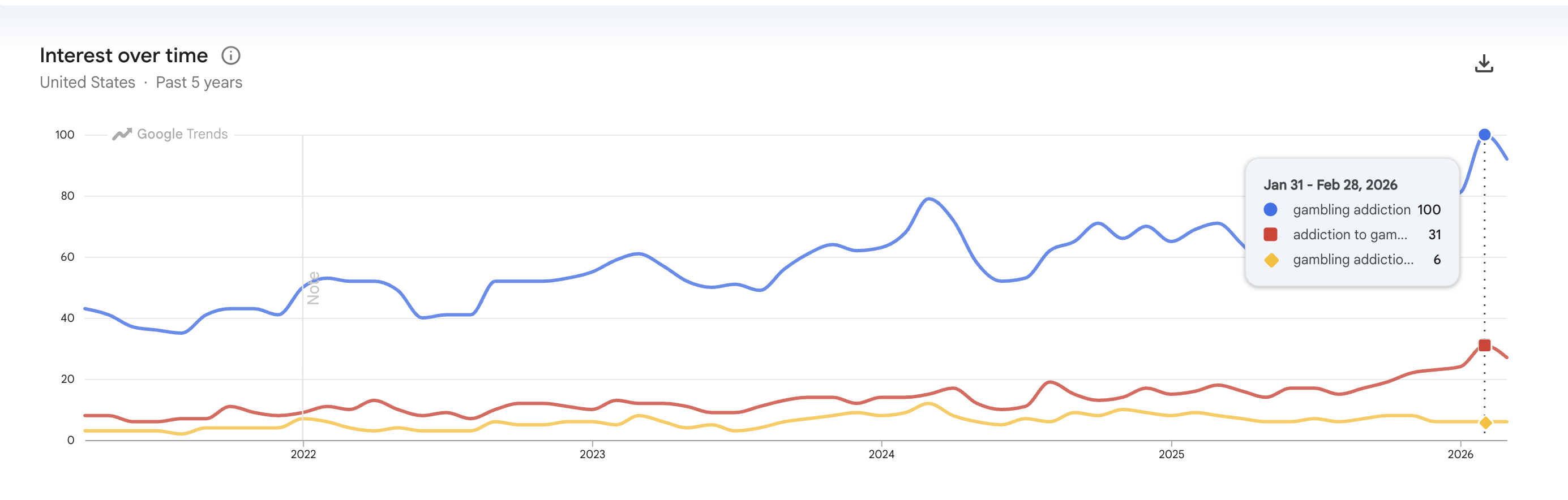
Search interest for "gambling addiction" reached its highest point in five years in early 2026, according to Google Trends data. This is not a blip. It is the result of five years of rapid expansion in legal sports betting, the rise of microbetting, sweepstakes casinos that disguise real gambling as social games, and prediction markets that have convinced a generation of young people that wagering on elections is not gambling.
The infrastructure to gamble has never been more accessible. The infrastructure to recover has barely kept up.
The Numbers Behind the Spike
The data tells a clear story of acceleration:
These are not abstract numbers. They represent people who opened a sportsbook account during a Super Bowl party and could not close it. People who downloaded a betting app on a Tuesday and were $3,000 in debt by Friday. People searching for help at 2 AM because their next therapy appointment is four days away.
What Changed: Five Accelerants
1. Legal sports betting went from zero to everywhere
In May 2018, the Supreme Court struck down the federal ban on sports betting in Murphy v. NCAA. Since then, 38 states have legalized it. The expansion happened faster than anyone predicted, and the public health infrastructure did not keep pace.
Research published in JAMA Internal Medicine found that in states that legalized online betting, there was a 10% increase in bankruptcy filings and an 8% increase in debt collection amounts, typically appearing about two years after legalization. Problem gambling rates have increased 30-50% in states that recently legalized.
2. Mobile betting removed every friction point
Around 80% of gamblers now use their phones. You can bet from bed, from the bathroom, from a work meeting. There is no casino to drive to, no cashier to face, no physical limit on how long you stay. The app is always open. The odds are always updating. The next bet is always one tap away.
This is fundamentally different from how gambling worked a decade ago. The removal of friction is not an accident. It is the core product design.
3. Microbetting compressed the addiction cycle
Traditional sports betting is one bet per game. Microbetting turns every pitch, every play, every possession into a new wager. A single NFL game can generate 130 to 150 individual betting opportunities, each resolving in seconds. The dopamine cycle that drives addiction, anticipation followed by outcome followed by repeat, now spins hundreds of times per session instead of once.
A major lawsuit filed in March 2026 by the Public Health Advocacy Institute alleges that microbetting platforms use AI to identify when users are most vulnerable and push targeted offers at exactly those moments.
4. Gen Z is the most affected demographic
The population at greatest risk is Gen Z (ages 18 to 29). Psychology Today reports that 37% of Gen Z respondents describe themselves as addicted to gambling, 14 percentage points higher than the average across all age groups.
Among college students, approximately 6% meet criteria for pathological gambling and another 10% show problem gambling behaviors. That is twice the rate of the general adult population. They grew up with smartphones, instant gratification, and gamified everything. Microbetting fits their behavioral patterns precisely.
The NCPG's national survey found widespread gambling participation before age 21, with approximately 60% of adolescents reporting they see gambling advertisements on social media.
5. Sweepstakes casinos and prediction markets expanded the definition
Sweepstakes casinos like Chumba Casino, Pulsz, and McLuck use a dual-currency model to operate without gambling licenses in most states. You buy "gold coins" (not real money, technically), receive free "sweeps coins" as a bonus, and can redeem sweeps coins for cash. It is gambling with extra steps, and it reaches people in states where traditional online gambling remains illegal.
Meanwhile, prediction markets like Polymarket and Kalshi have convinced millions of people that betting on elections, weather, and news events is "forecasting" rather than gambling. A Nevada judge saw through it. Most users have not.
The Gap Between Crisis and Care
Public perception is shifting. A Pew Research Center poll from 2025 showed that 43% of Americans think legalized sports betting is "a bad thing" for society, up from 34% in 2022. The concern is growing, but the treatment infrastructure is not growing with it.
Here is the reality:
- Gambling disorder has a 39% treatment dropout rate, higher than substance use disorders
- The hardest moments happen between therapy sessions, at 2 AM on a Tuesday, during halftime, on payday
- There are no real-time tools in most people's pockets for those moments except the gambling apps themselves
State-by-State Search Increases
When states legalized sports betting, searches for gambling addiction help followed. The UC San Diego study documented the pattern state by state:
| State | Legalized | Search Increase |
|---|---|---|
| Ohio | Jan 2023 | +67% |
| Pennsylvania | Nov 2018 | +50% |
| Massachusetts | Mar 2023 | +47% |
| Michigan | Jan 2021 | +37% |
| New York | Jan 2022 | +37% |
| Illinois | Jun 2020 | +35% |
| New Jersey | Jun 2018 | +34% |
| Virginia | Jan 2021 | +30% |
What Comes Next
The search trend line is not going to reverse on its own. Legal sports betting is expanding, not contracting. Microbetting is growing. Sweepstakes casinos are proliferating. And the generation most vulnerable to gambling addiction is the generation most immersed in the platforms that deliver it.
The question is not whether gambling addiction will continue to grow. It is whether the tools available to people in recovery will grow with it.
If you are reading this because the numbers describe you, here is what to do right now:
- Take a self-assessment to understand where you stand
- Learn how to block gambling apps on every device you own
- Call the National Problem Gambling Helpline: 1-800-522-4700 (24/7, free, confidential)
- Understand the 5-minute window that every urge follows
If you or someone you know is struggling with gambling, call the National Council on Problem Gambling helpline: 1-800-522-4700 (24/7, free, confidential). You can also text "GAMB" to 833-397-0571 or chat at ncpgambling.org.
Sources
- Google Trends. "Gambling addiction" search interest, United States, 2021-2026. trends.google.com.
- UC San Diego School of Medicine (2026). "Study Reveals Surge in Gambling Addiction Following Legalization of Sports Betting." Published in JAMA Internal Medicine.
- NPR (April 2026). "When Legal Sports Betting Surges, So Do Americans' Financial Problems."
- Harvard Gazette (January 2026). "Sports Betting Worries Grow as Wagers Skyrocket."
- Johns Hopkins Bloomberg School of Public Health (2025). "As Online Betting Surges, So Does Risk of Addiction."
- Psychology Today (April 2026). "March Madness and the Rise of Gen Z Sports Gambling."
- Psychology Today (March 2026). "Online Sports Gambling Risks Among Gen-Z Youth."
- National Council on Problem Gambling (2026). National Survey on Gambling Participation Before Age 21.
- Pew Research Center (2025). Public Attitudes Toward Legalized Sports Betting.
- NPR (February 2026). "The Rising Cost of Online Betting Addiction Among Young People."
- CNN (February 2026). "How Sports Gambling Addiction and Recovery Affects Men's Bonds."
- Good Morning America (2026). "Public Health Crisis: Experts Weigh the Stakes of Youth Gambling in America."
- American Gaming Association. Sports Betting Revenue Tracker, 2025-2026.
Related articles
Cope Compass is free.
Real-time support that learns your patterns and adapts to your recovery over time. The more you use it, the better it understands your triggers.
Try it now